Sunday, August 16, 2015
1996 CTX presentation by Bob Hallman
In 1996 we were in the middle of CTP revolution. Examples of CTP installations at RR Donnelley and others sparked interest in many major printers. With many technologies still battling for the position it was difficult for them to decide which system (laser platemaker) and which plates to use. Bob Hallman was busy visiting many major printer customers and giving his view of the industry trend in CTP. Internet surfing was not yet popular so that the face to face presentation was a very useful means of getting information short of visiting and spending time at the graphic arts shows. Bob at the same time brought back valuable customer inputs useful in guiding our R&D.
This Powerpoint presentation is just a glimpse of what he had been doing. Judging from the lack of final slide usually suggesting next step, this must have been a discarded or work in progress draft but you get the flavor of what he was saying.
Thursday, August 6, 2015
Silver Speed.... the product which never met "daylight"
Bill Streeter, an outstanding marketeer was sent by Powers Chemco to Europe to run its European arm in Holland. He has run the company successfully expanding into offset plate production and sales along with the traditional silver halide production and sales through their own organization throughout Europe. He was very much interested in new technology and invested heavily when the company suffered crushing currency exchange loss probably from Italian operation in early 1990's. He had to seek a buyer to bail out the sinking ship. He hoped the two new technology 1) silver halide catalyzed polymer system and 2) diffusion transfer printing plate similar to Silverlith by Hawthorn would attract buyers and bring necessary rescue fund. Unfortunately it appears no other company other than Polychrome was interested in the company. We saw a good fit in European silver film production and their sales network. We have determined, however, that the two technology was either too difficult to realize ( in case on #1) or not of high enough dot reproduction quality ( in case of #2). After the Polychrome's purchase of the Chemco Europe, we fully utilized their silver film production facility for local production but moved their plate operation to supplement our Sofia Bulgarian plant. As you know very well, the film production was shut down and the Bulgarian plant was merged to Osterode later on. So this very nicely made brochure of the Silverspeed (diffusion transfer plate) given to us to study the technology remains as the sole remnant of their new product development activity at the time.


Friday, July 24, 2015
from 1990 show
The back of these photo hasve date stamp saying Dec 1991 and are probably from the US show (Graphexpo?) I must have made extra copies of these photos later on. See all the young Polychromers.


Paul Reily, Victor Lopez and Gary Dolgins at the show.

New Product from Opti-copy

Cliff Coppinger admiring scale model of Fuji's US plant
Saturday, July 11, 2015
Polychrome is 50 yeas old
In 1986 we celebrated our 50th year since the founding of Polychrome and started to use special company logo. Here is Joe Piot:'s letter to announce the kick off. (Another contribution from Al W.)


Friday, July 3, 2015
Choke and Spread
Offset printing system depends on transfer of ink from plate to offset blanket and then from blanket to paper. Depending on how hard the pressure is set between each contact, ink spots are easily squeezed to fatten to produce darker than desired image. In order to compensate such "gain", halftone dots are reduced in size matching the printing machine's characteristics. It is easy nowadays to do this by simply adjusting tone reproduction curve on film/plate scanner but in 1980's there were no such digital equipment so that printers had to struggle to adjust (reduce) the dot size by adjusting exposure during the contact duplicating process. Depending on what the final plates is used, either choking (thinning the edge of dots of positive film for positive plates) or spreading (fattening dots to squeeze openings for negative plates) were used. And in 1980 duPont promoted the use of daylight film saying it reduces waste due to the bright lighting condition rather than the darkroom condition when regular high sensitivity film was also used for contact purpose. Seeing this to be a new trend Clark R&D focused on the development of daylight film, DLD and DLP around the time when I arrived Clark. When Al Wietling kindly sent me a bunch of samples, they brought vivid memory of how Gene Wilkerson with his aids worked day and night to develop these film. As I recall the duplicating film technology was a challenge but we came out with a superb product. After 35 years we now know these were short lived but was a profitable technology for us. I am sure most of the current members of graphic arts community would not recognize the word "choke and spread". But those who experienced the challenge and battle of film world would chuckle and say we were there to meet the market challenge successfully
.


.
.
Monday, June 22, 2015
Photos from 1989 Clark
These photos are from 1989 Clark plant.


Dr. Burt Waxman who ran R&D

Marv. Lieberman then plant manager later tapped to head Columbus construction and running of the plant in early days.

Mr. Shash Saraya of Polymer lab then co-housed in Clark facility

Mike Adelman who ran film marketing

Sal Lombardo who later moved to Columbus to run plate tech service

Nick Profeta visiting Clark from HQ
Tuesday, June 16, 2015
Luth trip 1991
Al Wierling sent in the pictures from trip in 1991 for contest winners.
Every year Luth, our film processor supplier and Polychrome had a contest for gross profit on film processor sales. As bests as I recall there were four contests, the winners and their spouses were given a free trip to a lovely locale. The first was to Copenhagen, the second to Paris, the third to St Thomas V.I, and the last to Vail Colorado. The winners included 4 TSR from each of the 4 regions, 1 branch manager, a regional mgr, film tech support people, our hosts from Luth and a person form corporate. Since I had a very good staff in Miami, I was able to go to the last three trips, mission only the Copenhagen trip, a city still on my bucket list.
Our hosts from Luth were very generous and to this day I ama very grateful to Peter Bandholm and wife (Greta?) and Bruce Goodwin and wife.
The attached pics are from the 1991 trip to St Thomas and we all had avery good time.
Hopefully the names on the back of the photos are correct.
Thanks Al for sharing these pictures from good old days!

Al and Pat Wireline

John and Fran Sturgis

Jeff Silva and his wife

Victor and Anne Lopez

Ron and Mary Ann Mangis

Albert Garcia and his wife

Peter and Greta(?) Brandhlm , Luth


Szulc, Mangis and Pat Wireline

Bruce Goodwin and his wife, Luth
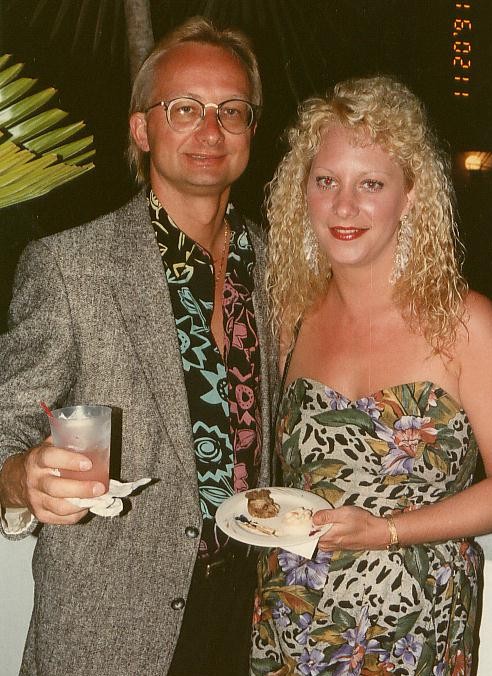
Tom Szulc and his wife

Our hosts from Luth
Subscribe to:
Posts (Atom)